Home » 2026 Rovee-Collier Mentor Award Winner: Catherine Monk, PhD
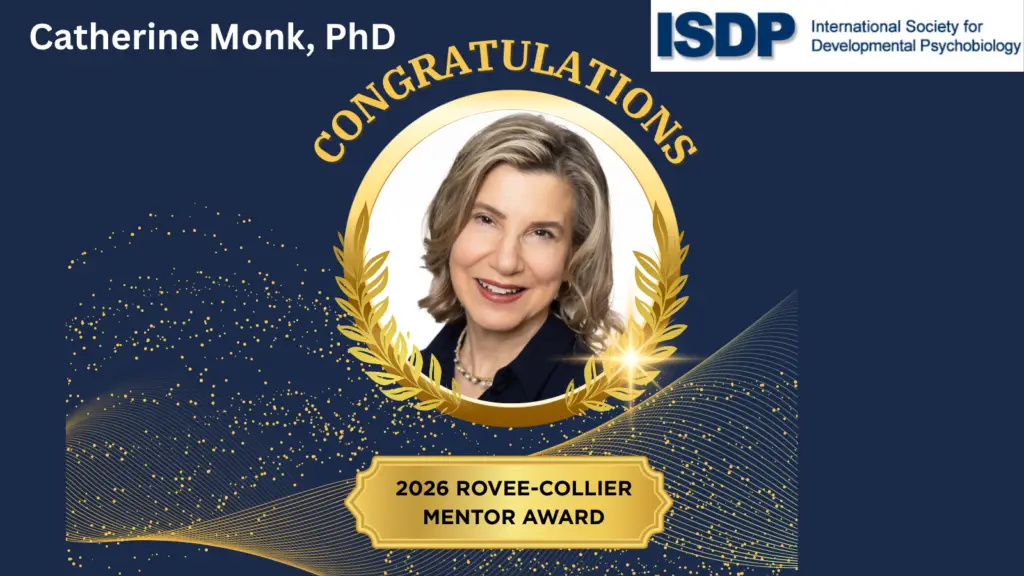
2026 Rovee-Collier Mentor Award Winner: Catherine Monk, PhD
Catherine Monk, Ph.D. Diana Vagelos Professor of Women’s Mental Health Chief, Division of Women’s Mental Health Department of Obstetrics & Gynecology Professor of Medical Psychology Department of Psychiatry Columbia University Vagelos College of Physicians and Surgeons
Catherine Monk, PhD, is the Diana Vagelos Professor of Women’s Mental Health and Chief, Division of Women’s Mental Health, in the Department of Obstetrics & Gynecology (Ob/Gyn) and Professor of Medical Psychology in the Department of Psychiatry at Columbia University Vagelos College of Physicians and Surgeons. She also is a Research Scientist at New York State Psychiatric Institute. Dr. Monk, a practicing clinical psychologist, directs Women’s Mental Health @Ob/Gyn, an integrated clinical service within Ob/Gyn. She and collaborators recently launched the research-to-practice Center for the Transition to Parenthood http://vagelos.columbia.edu/transitiontoparenthood to enhance the perinatal ecosystem for 2Gen impact. Dr. Monk’s DOHaD and perinatal intervention research have been continuously funded by the National Institute of Health (NIH) since her NIH Career Development award in 2000 as well as by numerous foundations including the Bezos Family Foundation, the Robin Hood Foundation, Perigee Fund, March of Dimes, and the Brain and Behavior Research Foundation.
Former ISDP Rovee-Collier Mentor Award Winners:
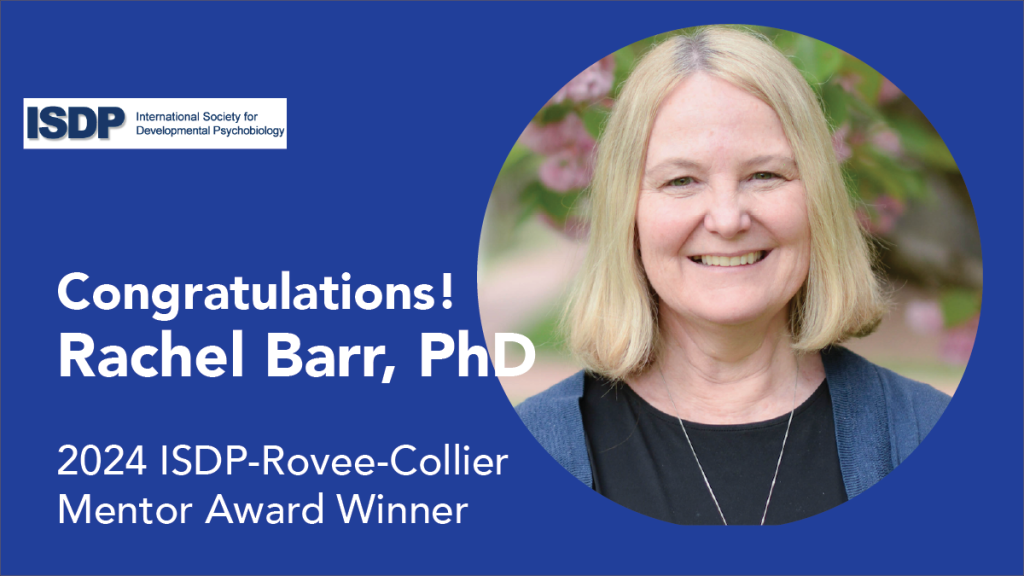
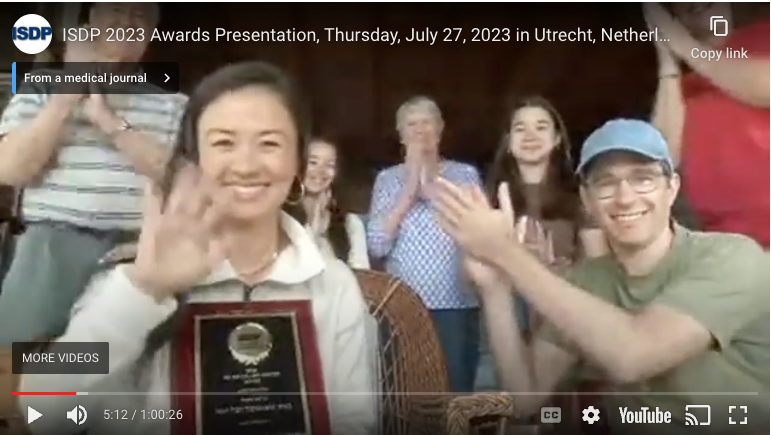
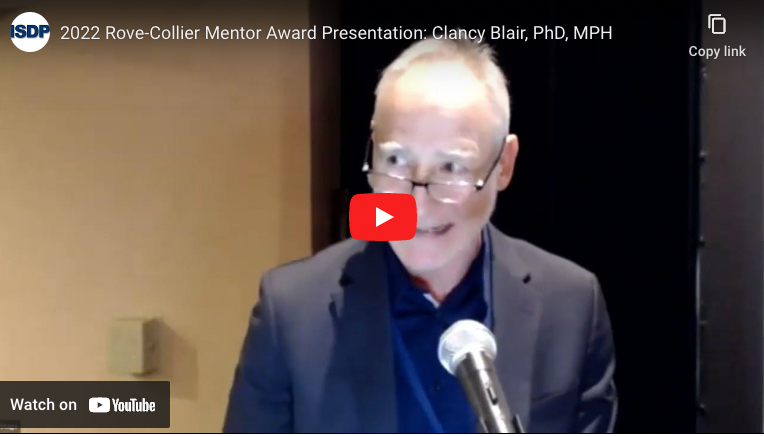
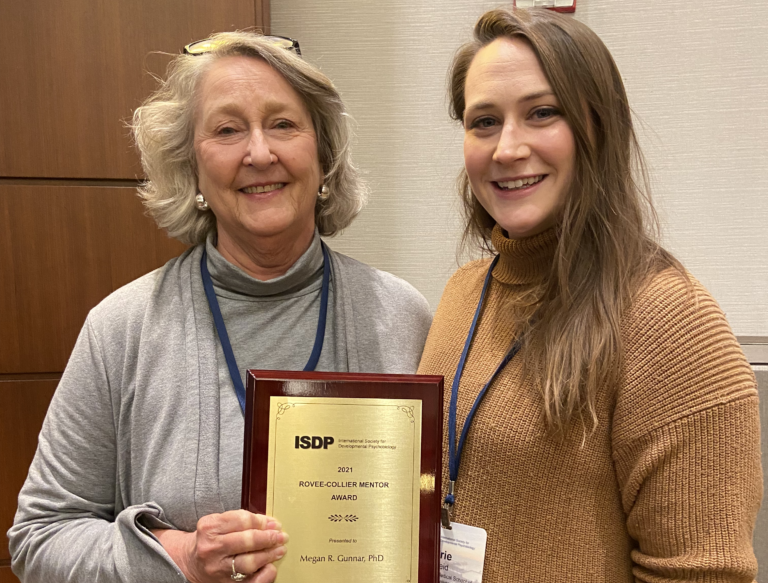
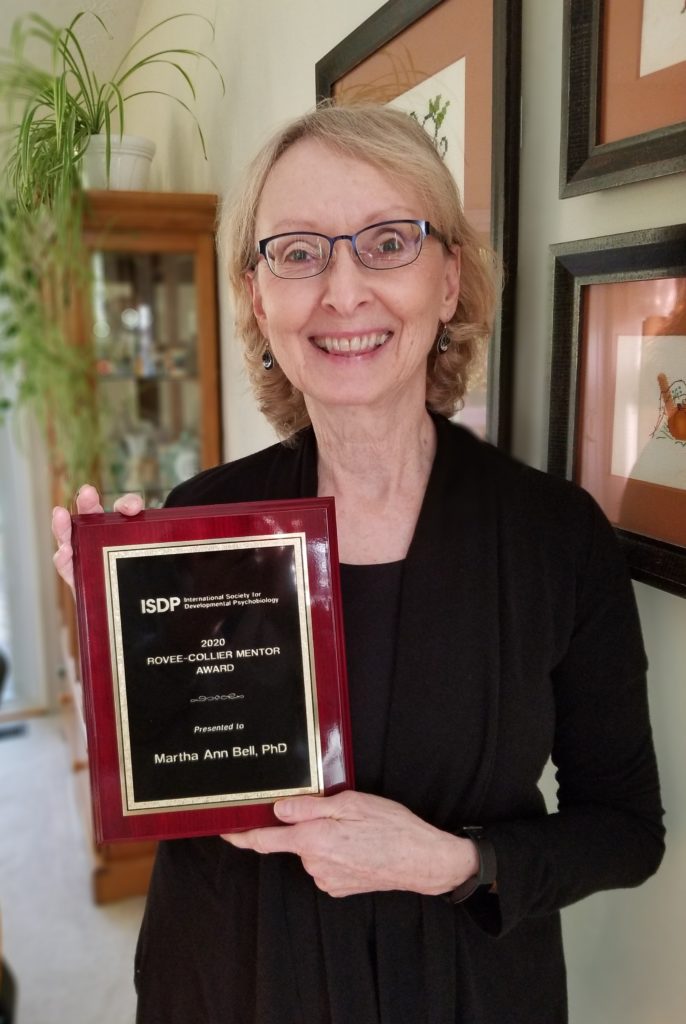
2024 ISDP Rovee-Collier Mentor Award Winner is Rachel Barr, PhD MORE
Carolyn Rovee-Collier (April 7, 1942 – October 2, 2014)
Carolyn Rovee-Collier
Carolyn Rovee-Collier (April 7, 1942 – October 2, 2014) was a Professor of Psychology at Rutgers University. She was a pioneer and an internationally renowned expert in cognitive development. Over the course of her distinguished career, Carolyn received numerous honors and awards including the Senior Scientist Lifetime Contribution Award from the International Society for Developmental Psychobiology. She was elected to The Society of Experimental Psychologists in 1999 and received that society’s prestigious Howard Crosby Warren Medal in 2003. Carolyn received a James McKeen Cattell Fellowship, a Medal for Distinguished Achievement from the Brown University Graduate School, and the biannual Award for Distinguished Scientific Contributions to Child Development from the Society for Research in Child Development. Her oral history has been recorded and placed in the public archive of The Society for Research in Child Development’s Oral History Project. Carolyn’s research on infant learning and memory received continuous NIH funding for over 35 years, including an NIMH MERIT Award and two successive NIMH Research Scientist Awards. She served for 18 years as Editor of Infant Behavior & Development in addition to serving as co-editor (with Lipsitt) of Advances in Infancy Research (Vols. 3–12), President of the International Society for Developmental Psychobiology, the International Congress of Infant Studies and the Eastern Psychological Association.
Carolyn was also a firm believer in serendipity. Her hallmark task, the mobile conjugate reinforcement paradigm, was developed as a means to settle her own fussy infant. While trying to write her dissertation, Carolyn used a hair ribbon to connect her son’s ankle to his overhead mobile. She stood by her son’s crib and watched as he quickly learned to control both the rate and vigor of the mobile’s movements by altering his foot kicks. Her first publication (Rovee & Rovee, 1969) set the stage for the uphill scientific battle that would dominate her career. Her demonstration of operant conditioning by very young human infants flew in the face of traditional Piagetian theory. Despite her rigorous experimental methods, it took years to get that paper published. Her subsequent work on infant long-term memory (Rovee & Fagen, 1976; Rovee-Collier, Sullivan, Enright, Lucas, & Fagen, 1980) was similarly controversial because it was inconsistent with the prevailing view that infant memory was poor. Her theoretical work presents a direct challenge to current neural models of memory development (Rovee-Collier & Giles, 2010; Rovee-Collier, Hayne, & Colombo, 2001).
Above all else, Carolyn was highly committed to training graduate students and other emerging researchers. Over the course of her career, she mentored dozens of PhD, master’s, and undergraduate research students. She taught them everything that they needed to know to succeed in their careers — for example, that spelling counts, and that just because a reviewer (or an editor) says something doesn’t make it so. Most importantly, she taught them that some battles are definitely worth fighting. Like any great coach, Carolyn pushed people to their limits, but she never asked more from others than she was willing to do herself. She was always the first person in the lab in the morning and the last one to leave. Working with Carolyn was a cross between boot camp and a luxurious bed and breakfast: She might keep you up working for 2 to 3 nights in a row, but during that time, she generously provided ample amounts of home cooking and southern hospitality. For those of us who had the privilege of working with her, Carolyn Rovee-Collier was always our staunchest critic and our fiercest ally. Speaking on behalf of her students, her postdocs, her colleagues, and her friends, it is safe to say that we all drew an immeasurable degree of personal and professional strength knowing that Carolyn was in our corner. The Carolyn Rovee-Collier mentorship ISDP Award celebrates this level of support in other exceptional ISDP mentors.
This website uses cookies to improve your experience. We'll assume you're ok with this, but you can opt-out if you wish. Cookie settingsACCEPT
Privacy & Cookies Policy
Privacy Overview
This website uses cookies to improve your experience while you navigate through the website. Out of these cookies, the cookies that are categorized as necessary are stored on your browser as they are essential for the working of basic functionalities of the website. We also use third-party cookies that help us analyze and understand how you use this website. These cookies will be stored in your browser only with your consent. You also have the option to opt-out of these cookies. But opting out of some of these cookies may have an effect on your browsing experience.
Necessary cookies are absolutely essential for the website to function properly. This category only includes cookies that ensures basic functionalities and security features of the website. These cookies do not store any personal information.
Any cookies that may not be particularly necessary for the website to function and is used specifically to collect user personal data via analytics, ads, other embedded contents are termed as non-necessary cookies. It is mandatory to procure user consent prior to running these cookies on your website.