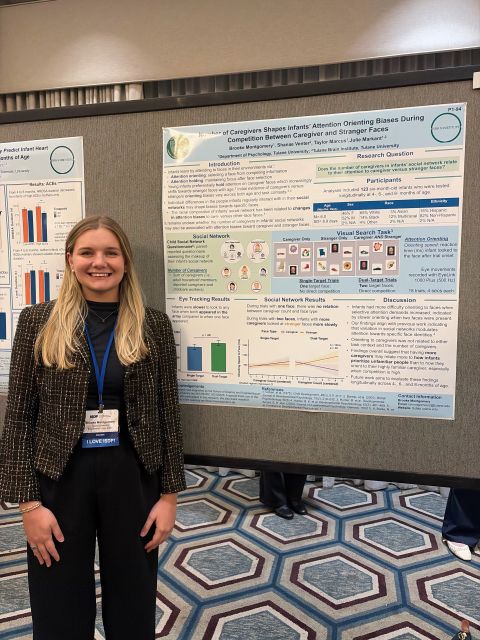
P1.94 NUMBER OF CAREGIVERS SHAPES INFANTS’ ATTENTION ORIENTING BIASES DURING COMPETITION BETWEEN CAREGIVER AND STRANGER FACES.
Brooke Montgomery1, Shanae Venter1,2, Taylor Marcus1, Julie Markant1
1 Tulane University, New Orleans, USA
2 New York Medical College, Valhalla, USA
Abstract Body
Young infants are biased to attend to their own caregiver’s face but increasingly prefer to look to stranger faces over the first year (Bartrip et al., 2001). However, the mechanisms underlying this shift in infants’ attention to faces remain unclear. Attention biases are shaped by infants’ experiences with faces (Markant & Scott, 2018). Diversity within infants’ social networks predicted their attention to own- and other-race faces (Arnold et al., 2024), suggesting that infants’ social network variation may similarly influence attention biases to caregiver and stranger faces.
We examined whether the number of caregivers in infants’ social networks predicted their orienting to caregiver versus stranger faces. We used eye tracking to measure 6-month-old infants’ (N = 107) orienting to faces within 6-item arrays. During single-target trials one face (primary caregiver or stranger) appeared in the array, whereas dual-target trials included two faces (primary caregiver and stranger). Caregivers completed the Child Social Network Questionnaire (Burke et al., 2022). We computed infants’ total social network size (SNS) and total number of caregivers (i.e., adult household members, reported caregivers, and childcare providers).
After controlling for total SNS, we found no differences in orienting speeds during single-target trials (p = .82). During dual-target trials, infants with more caregivers oriented more slowly to stranger faces (p = .01), whereas infants’ orienting to their primary caregiver’s face was stable (p = .17). These results suggest that caregiving experiences may enhance the attention bias to primary caregivers as orienting to strangers may be inhibited when both faces appear together.
Research Subjects
Humans
Please choose an AGE or AGES from the list below associated with the research discussed in this abstract:
infancy