Submission Deadline Extended to June 15th
ISDP 2026: 59th Annual Meeting of the International Society for Developmental Psychobiology
November 11-13, Crowne Plaza New Orleans, USA
Countdown to the Abstract Submission Deadline Extended to: June 15, 2026
Abstract Submission Deadline Countdown Expired!
Program Committee:
Program Chair:
Bridget Callaghan, University of California, Los Angeles
Program Co-Chair:
Julie Campbell, Illinois State University
Conference Organizers:
Elisabeth Conradt, Associate Professor in Psychiatry at Duke University
Helena Rutherford, Associate Professor in the Child Study Center, Yale Child Study Center
Executive Committee:
Koraly Pérez-Edgar, The Pennsylvania State University
Heather Brenhouse, Northeastern University
Tania L. Roth, University of Delaware
Conference Staff:
Joan Oefner, Managing Director, ISDP email
Hannah Oefner, Conference Manager, ISDP email
The Annual Meeting of the ISDP includes oral and poster sessions for individual, free-standing research presentations which benefit both the presenters and audience from high levels of interaction and discussion. We encourage lively debate and discussion during these interactive oral and poster sessions. A nonrefundable abstract fee of $50 will be due at the time of submission. Abstracts must be finalized, including payment of the nonrefundable $50 submission fee, before the submission deadline. By submitting an abstract, you agree to present at the ISDP Meeting should your abstract be selected for the program.
ISDP Student/Postdoc Member Travel Awards:
Important Dates:
March 31, 2026 | Symposium Proposal Deadline |
| June 1, 2026 | ISDP Student/Postdoc Travel Award Application Deadline |
| June 1, 2026 | Abstract Submission Deadline |
July 25, 2026 | Early Registration Deadline |
| September 14, 2026 | Refund/Cancellation Deadline |
| September 14, 2026 WHILE SUPPLIES LAST | Hotel Reservation Deadline |
| September 15, 2026 | Regular Registration Deadline |
| October 20, 2026 | Late Poster Abstract Submission Deadline |
| November 11-13, 2026 | ISDP Annual Meeting Dates |
Abstracts should be submitted using the online form. You will be given three options for submission of your abstract:
- Standard Abstract Submission (for data analysis that has already been completed for the study)
- Pre-registration (for a study that is planned/underway, or includes data that has been collected but not yet analyzed)
- Policy Practice & Advocacy (submissions that focus on specific policy implications or extensions of developmental science; does not need to include data)
ABSTRACT TITLE (MUST BE IN ALL CAPITAL LETTERS). This will be used for printing in the final program. Submit the TITLE of your abstract in ALL CAPS to comply with the publisher’s formatting instructions. For example:
MECHANISMS FOR A DEVELOPMENTAL CRITICAL PERIOD OF HIPPOCAMPAL LEARNING
How you choose to enter your information is how it will appear to the public if your abstract is selected. Do NOT include the authors, institutions or contact information in the TITLE of the abstract and ONLY the ABSTRACT TITLE should be in ALL CAPS.
The body of your abstract should NOT INCLUDE your ABSTRACT TITLE or the authors, affiliations and contact information which will be included in the Authors section. The body of the abstract must not exceed 250 words to comply with the publisher’s formatting instructions (not including authors or TITLE). You will be advised of your word count usage throughout the submission process as you save and move to the next step.
Virtual presentation of ePosters will be available but no virtual sessions and all presenters must be registered for in-person registration as there will be no virtual platform this year. The online abstract/program includes a poster gallery with optional pdf upload of the posters, as well as the option to include a video presentation and all meeting participants can choose whether to include the networking options for chat, direct chat and group chat, users can always opt out. Each poster can also include email, Twitter, LinkedIn Facebook and Instagram. We will not allow download of the poster pdf’s and although the ePoster submission is optional, we highly recommend utilizing these additional poster networking features.
- Digital ePosters are automatically tied to the original abstract record
- Once scheduled, the ePoster will display in our online program and in a digital poster gallery organized automatically by topic, ID, title, speaker and organization.
- Discussion boards are embedded for Q&A and ongoing discussions
- ePosters will be available for all registered attendees and all oral and poster abstracts will be included in the abstract publication in Developmental Psychobiology. We encourage participants to use the networking features to invite meeting attendees to visit your ePosters, as well as Twitter (highly encouraged) #isdp2026.
You will be given three options for submission of your abstract:
- Standard Abstract Submission (for data analysis that has already been completed for the study)
- Pre-registration (for a study that is planned/underway, or includes data that has been collected but not yet analyzed)
- Policy Practice & Advocacy (submissions that focus on specific policy implications or extensions of developmental science; does not need to include data)
Abstract Submission Categories:
- Models of Neurodevelopmental Disorders
- Physiological Processes including hormonal modulation
- Socio-emotional including attachment & temperament
- Perception
- Sleep
- Neurodevelopment and Plasticity including imaging work
- Learning
- Memory
- Cognitive Processes
- Genetics and Epigenetics
- Stress
- Adversity
- Cultural Influences
- Sensori-motor development
- Parental behavior such as maternal or paternal or parent-child interactions
- GxE Interactions
Please choose an AGE or AGES from the list below associated with the research discussed in this abstract:
- prenatal
- infancy
- adolescence
- adult
- aging
Please choose one or more Research Species Categories related to this abstract:
- Humans
- Non-human primates
- Rodents
- Invertebrate
Testimonials from past ISDP Annual Meeting Participants:
- “The choice of talks and presenters was great. The collaborative atmosphere of the conference was excellent.”
- “Ability to connect with top researchers in the field due to the small, intimate nature. Stepping out of my wheelhouse to listen to presentations not typically thought of as being related to my research.”
- “The variety of presentations from a diverse group of presenters (graduate students, post-docs, PIs, basic and clinical) made for a really excellent conference.”
- “I like the fact that the speakers included both very early career scientists and leaders in the field. I also really liked that there was a good representation of different methods (fMRI, behavioral observation, rodent models, etc) and approaches.”
Questions or More Information:
Hannah Oefner, Abstracts Support
E-mail
Tel. and WhatsApp: +49 171-1082-070
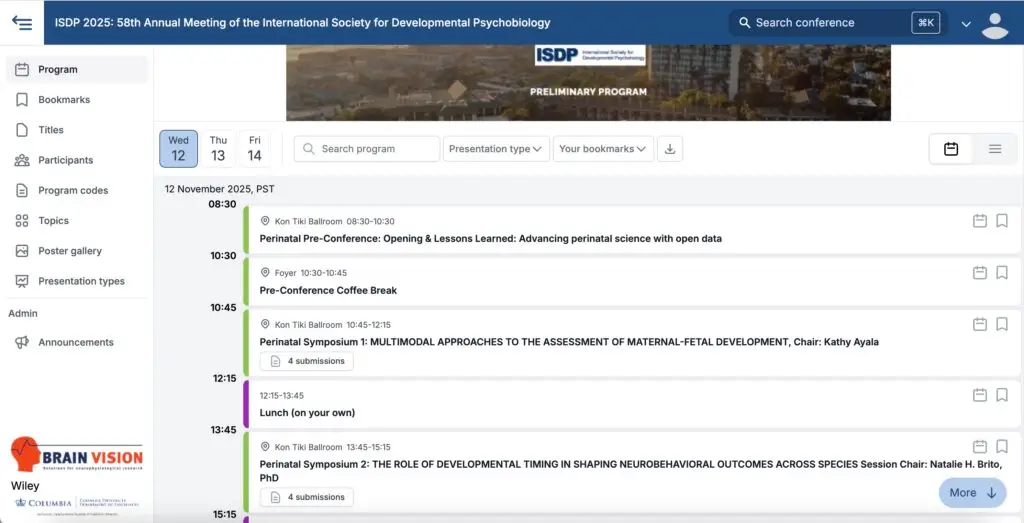
View the online program & abstracts from ISDP 2025 in San Diego