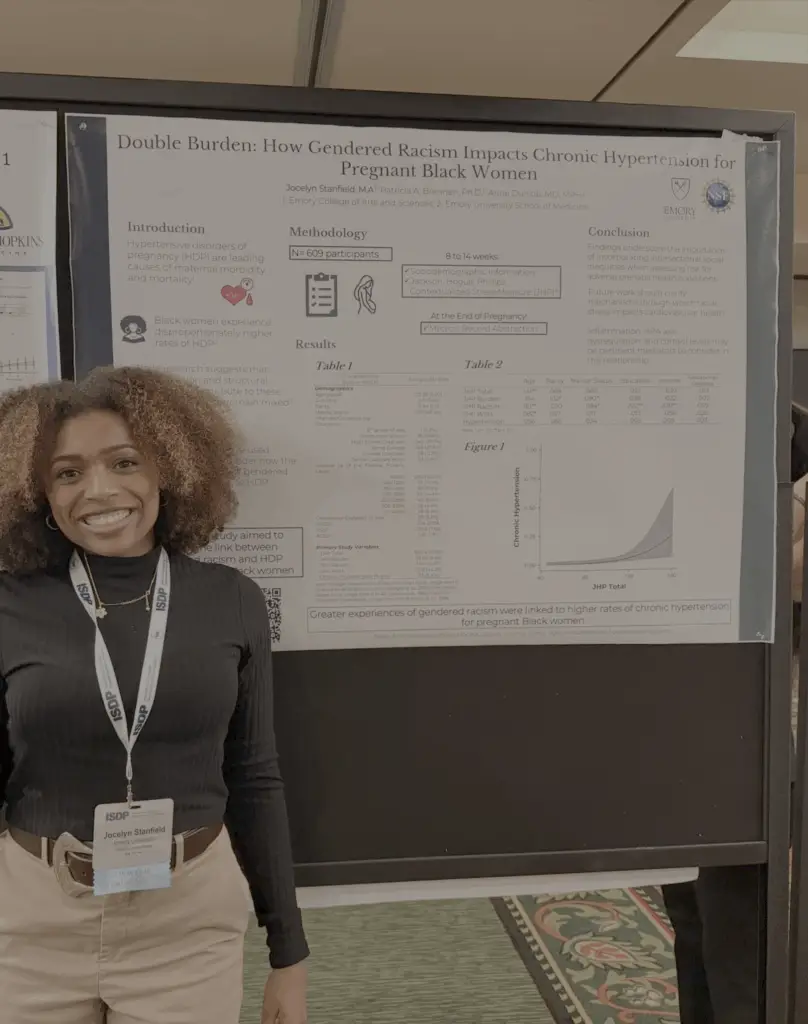
Advisor: Patricia Brennan, Ph.D. Samuel Candler Dobbs Professor of Psychology Emory University Psychology and Interdisciplinary Sciences Abstract Body Hypertensive disorders of pregnancy (HDP) are leading causes of maternal morbidity and mortality. Individuals with HDP face heightened long-term cardiovascular risk, even after controlling for traditional risk factors. Notably, Black women experience disproportionately higher rates of HDP. While some research suggests that racism may contribute to these disparities, findings remain mixed. Critically, no studies to date have examined these associations through an intersectional lens that considers how experiences of gendered racism – discrimination arising from the combined effects of being both Black and female – might influence HDP. To address this gap, the current study explored the link between gendered racism and HDP among pregnant Black women. 608 participants reported their experiences of gendered racism on a questionnaire designed to capture the unique stressors tied to both racial and gender identity within this population. HDP diagnoses were ascertained via medical record abstraction. Linear regressions revealed that while gendered racism was not significantly related to gestational hypertension, preeclampsia, or a composite measure of HDP, it was significantly associated with chronic hypertension. That is, greater experiences of workplace gendered racism (β= 0.11, p= 0.005) and more frequent exposure to racist rhetoric (β= 0.10, p= 0.014) were linked to higher rates of chronic hypertension. These findings underscore the importance of incorporating social inequities when assessing risk for adverse prenatal health conditions. Future research should clarify the mechanisms through which racial stress impacts cardiovascular health to better address its effects on maternal well-being and subsequent child development.
This website uses cookies to improve your experience. We'll assume you're ok with this, but you can opt-out if you wish. Cookie settingsACCEPT
Privacy & Cookies Policy
Privacy Overview
This website uses cookies to improve your experience while you navigate through the website. Out of these cookies, the cookies that are categorized as necessary are stored on your browser as they are essential for the working of basic functionalities of the website. We also use third-party cookies that help us analyze and understand how you use this website. These cookies will be stored in your browser only with your consent. You also have the option to opt-out of these cookies. But opting out of some of these cookies may have an effect on your browsing experience.
Necessary cookies are absolutely essential for the website to function properly. This category only includes cookies that ensures basic functionalities and security features of the website. These cookies do not store any personal information.
Any cookies that may not be particularly necessary for the website to function and is used specifically to collect user personal data via analytics, ads, other embedded contents are termed as non-necessary cookies. It is mandatory to procure user consent prior to running these cookies on your website.