Assistant Professor, Boston University Department of Psychological and Brain Sciences Center for Systems Neuroscience Neurophotonics Center
Abstract Body
Adolescence is a sensitive window of neurodevelopment during which experiences can have lasting effects on cognition and behavior. In particular, plasticity in the neural circuits that process fear opens up a period during which experiences can shape later responses to threat and stress.
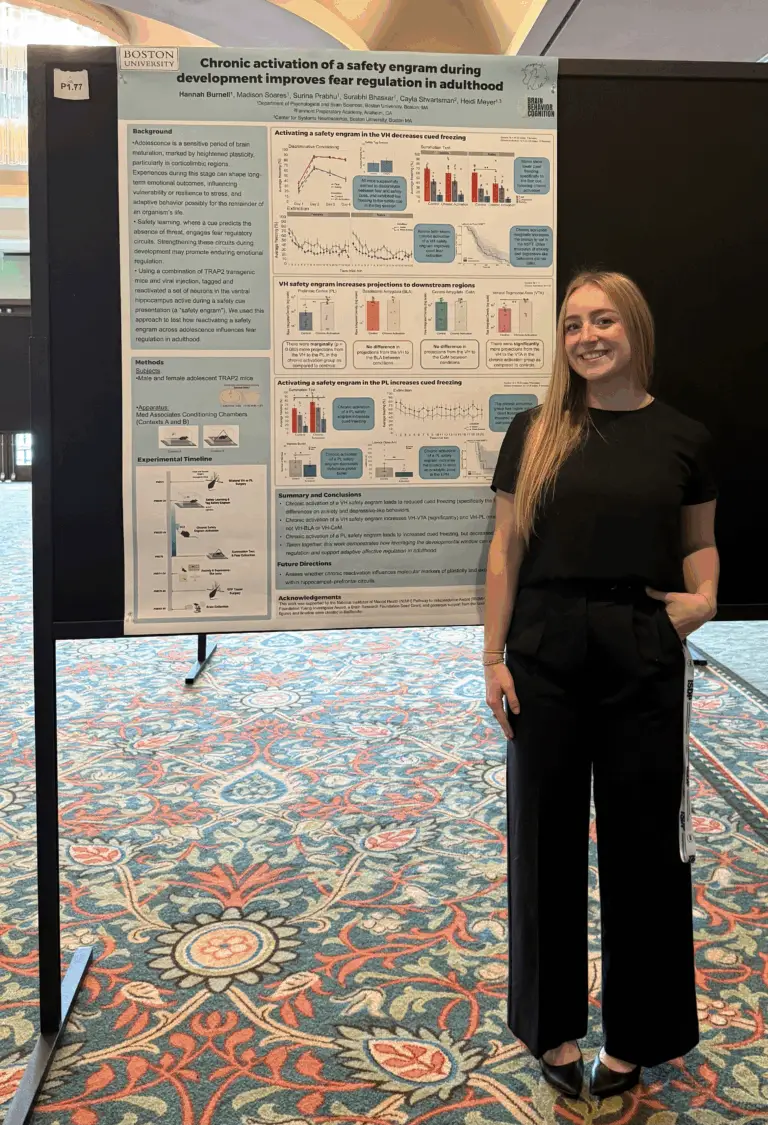
Here, we tested whether driving an experience through adolescence improves fear regulation in adulthood. Mice were trained to discriminate between a fear cue (tone paired with footshock) and a safety cue (second tone, never paired with shock). Using a knock-in mouse for activity-dependent genetic labeling (TRAP2), we tagged a neuronal ensemble active during the safety cue (safety engram), then chronically reactivated this safety engram across adolescence and the transition into adulthood (postnatal days 35 to 69) using an excitatory chemogenetic approach.
Behavioral testing in adulthood revealed no significant differences in behavior across anxiety- and depressive-like tests (elevated plus maze, marble burying, tail suspension, and novelty suppressed feeding). Conversely, developmental reactivation significantly reduced cued fear in adulthood. Freezing to the previously conditioned fear cue was lower during both a summation test for conditioned inhibition and fear extinction. Furthermore, developmental reactivation accelerated fear extinction. Ongoing work is evaluating the impact of safety engram reactivation on structural connectivity between the hippocampus and prefrontal cortex.
These findings suggest that reactivating hippocampal safety ensembles during adolescence can enhance long-term cued fear regulation without altering affective behavior broadly. This informs the potential to leverage developmental windows to promote adaptive emotional regulation strategies throughout the lifespan.
This website uses cookies to improve your experience. We'll assume you're ok with this, but you can opt-out if you wish. Cookie settingsACCEPT
Privacy & Cookies Policy
Privacy Overview
This website uses cookies to improve your experience while you navigate through the website. Out of these cookies, the cookies that are categorized as necessary are stored on your browser as they are essential for the working of basic functionalities of the website. We also use third-party cookies that help us analyze and understand how you use this website. These cookies will be stored in your browser only with your consent. You also have the option to opt-out of these cookies. But opting out of some of these cookies may have an effect on your browsing experience.
Necessary cookies are absolutely essential for the website to function properly. This category only includes cookies that ensures basic functionalities and security features of the website. These cookies do not store any personal information.
Any cookies that may not be particularly necessary for the website to function and is used specifically to collect user personal data via analytics, ads, other embedded contents are termed as non-necessary cookies. It is mandatory to procure user consent prior to running these cookies on your website.